
























































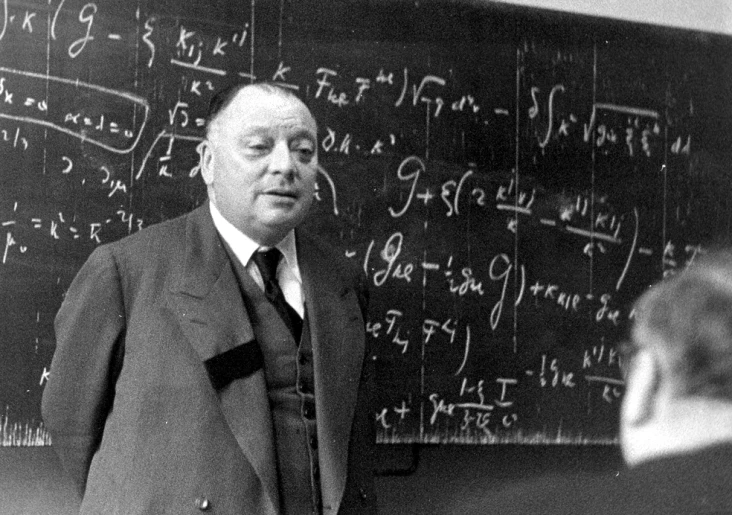
The article aims to highlight the most important events in Pauli’s life, mentioning the people he collaborated with, his contributions in the field of physics as we know it today and concluding quotes about Pauli and quotes attributed to Pauli.
Wolfgang Pauli is a prominent figure in the field of physics of the twentieth century, which is not easy given that he was a contemporary of big names such as Einstein, Planck, Heisenberg, Dirac and so on. Read more about the physicist.
early
Wolfgang Ernst Friedrich Pauli was born on April 25, 1900, in Vienna. His father, Wolf Pascheles, was a member of a famous Jewish publishing family in Prague, who had studied medicine and attended Ernst Mach’s physics classes, which later became Pauli’s baptismal nose. He had settled in Vienna a few years ago and had converted to Catholicism for professional reasons, changing his name to Wolfgang Josef Pauli. The physicist’s mother, Berta Camilla Pauli, was a well-known journalist and active feminist.
Pauli had a sister, Herta, with whom she shared a passion for literature and astronomy. After primary school, Pauli became a student at the Humanities Gymnasium in Vienna – Dobling, being part of the genius class. He had an innate talent for mathematics, already reading Euler’s papers at the age of 13. He is said to have read Einstein’s works secretly during class.
University studies
Although he was tempted to pursue a career in literature, Pauli eventually chose to become a physics student at Lugwig-Maximilians University in Munich. Here he had Arnold Sommerfeld as his physics teacher, being impressed by his knowledge of mathematics and physics. Sommerfeld is collaborating with Niels Bohr to develop a hybrid atomic model between classical and quantum mechanics. Also on the bench, Pauli meets Werner Heisenberg, with whom he will have a lifelong friendship.
Sommerfeld is impressed by Pauli’s ability to formulate clear and precise sentences about physical phenomena, so he is instructed to write the chapter on the Theory of Relativity in the Encyclopedia of Mathematical Sciences, which Einstein had refused to write. too busy. Pauli’s work is a success, remaining a standard in the field over time. After only 6 semesters, Pauli graduated “summa cum laudae” from the university, with a paper on the trajectory of electrons around the H2 + ion.
Career
In 1921 he became an assistant to Max Born at the University of Gottingen. Next year he has the opportunity to meet Niels Bohr. Following numerous discussions with Bohr, Pauli received an invitation to the University of Copenhagen, where he spent a year discussing atomic models with Bohr, making a valuable contribution to his advanced knowledge of mathematics.
In 1923 he became Wilhelm Lenz’s assistant at the University of Hamburg, as part of the newly established Institute of Theoretical Physics. In 1924 he postulated the principle of exclusion, also known as Pauli’s principle, by introducing a new quantum number, the fourth, which would later be called the spin of the electron by Goudsmit and Uhlenbeck.
Pauli’s principle reads as follows: In a single atom it is impossible to have two or more equivalent electrons for which in strong fields the values of the 4 quantum numbers are identical.
In 1928 he was invited to become a full professor at the Federal Institute of Technology (ETH) in Zurich, in the physics department headed by Paul Scherrer. He frequently organizes “physics weeks” here, the Swiss city becoming an important center of theoretical physics.
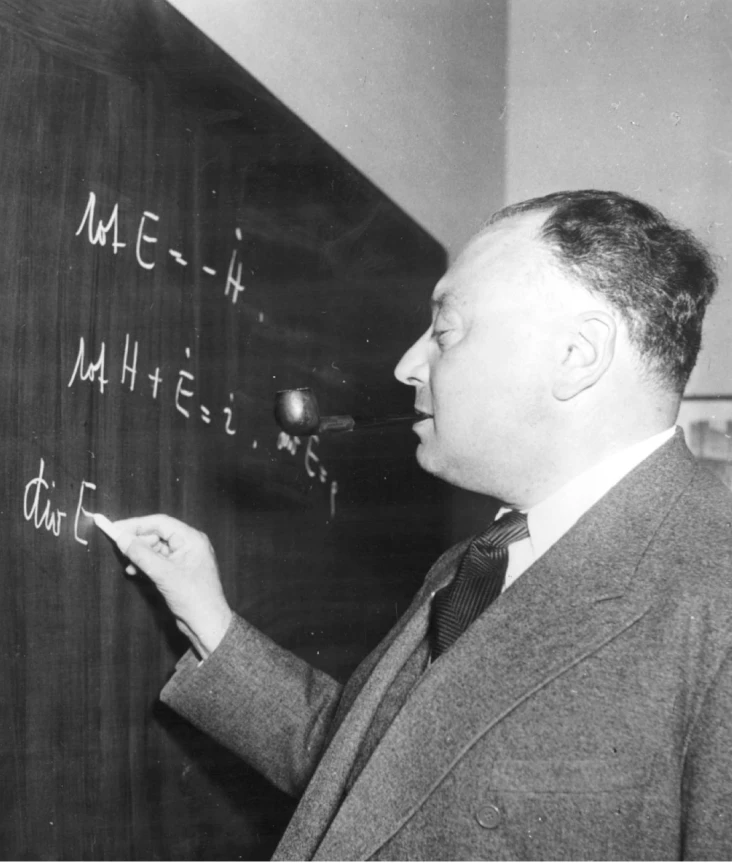
Pauli did not have an extraordinary talent for giving presentations in front of a crowd, but he had the extraordinary gift of writing scientific papers. He also had a penchant for private physics classes, succeeding in turning all his assistants into renowned physicists.
Although he acknowledged the importance of experimental physics as a means of verifying theories, he never attempted to make contributions in this area, stating: “I understand too little about experimental physics.” That’s why he joked about a second principle of Pauli’s: “It’s impossible for Professor Pauli and a functional device to coexist in the same room.”
During his teaching career in Zurich, he studied the beta radioactive decay, trying to explain why the principle of energy conservation seemed contradicted by it, and postulating the existence of a light particle without electric charge, which he called a “neutron.” In 1931 he presented this idea at a conference in Pasadena. The New York Times writes: “A new inhabitant of the heart of the atom was introduced into the world of physics today when Professor Wolfgang Pauli of the Institute for Theoretical Physics in Zurich, Switzerland, postulated the existence of a particle or entity which he named. neutron”. The name neutron will eventually be given to the particle discovered by Chadwick, and Pauli’s particle will receive in 1934 the name known today as “neutrino”, a name created by Enrico Fermi.
Between 1935 and 1936 he was a visiting professor at the Institute for Advanced Study at Princeton University, where he was elected full professor in 1940, but chose to return to Zurich, where he will teach until the end of his life. What led him to leave the United States was to drop the atomic bomb at the end of World War II, which angered the US authorities.
The principle of exclusion postulated in 1924 brought him the Nobel Prize in 1945. It was Einstein who nominated him for this distinction. Pauli contributed to the foundation of quantum field theory and actively participated in the great advances made in 1945. Together with Paul Scherrer he became involved in the founding of CERN, and in 1955 organized in Berlin “50 years of the Theory of Relativity”. He writes numerous articles on problems in theoretical physics, especially quantum mechanics.
He was a member of the Royal Society of London and the Swiss Physical Society, the American Physical Society and the American Association for the Advancement of Science. He received the Lorentz Medal in 1930, the Franklin Medal in 1952 and the Max Planck Medal in 1958.
Wolfgang Paul’s man
Pauli is characterized by his contemporaries as a perfectionist, a person with a sense of humor and always ready to help. He was always skeptical and critical, being called “the terrible Paul” or “God’s hostage.”
He was reluctant to make political statements and often mocked his clumsiness by saying that he needed 100 hours of practice to get his driver’s license.
He wrote 11 books and 93 articles, but perhaps the most important part of his contribution to physics can be found in the 2000 letters he collected in his correspondence with big names in physics such as Heisenberg, Schrodinger and others. Many of the ideas of these scientists came from Pauli.
He was married to Francisca “Franca” Bertram. He was passionate about psychology, being good friends with the psychoanalyst Carl Jung. During college he was famous for his night getaways, for his active social life and for the fact that he often missed classes in the morning.
In 1958 he died in Zurich of a gastric ulcer. His grave is in the town where he lived, Zollikon.
Quotes about Wolfgang Pauli
Albert Einstein, referring to the chapter on the Theory of Relativity written by Pauli, said: It is unknown at this time what he will do after leaving the post.
Max Born, the first teacher Pauli attended: “He is surprisingly intelligent and maybe very smart. I will never have such an assistant again. ”
Kronig and Weisskopf: “His published papers do not contain, however, Pauli’s critical attitude, but only a small part of his work. Pauli relates in his treatises only the final results, but nothing about the long, often difficult road that led to these results. Some of his silent work is revealed in his rich correspondence. ”
Heisenberg: “I have never published a work without Paul having read it before.”
Weisskopf: “What would Pauli say about this?”, “Pauli will never accept that!”
Klein: “It had gradually become a kind of institution, where you could present your ideas without being afraid of excessive politeness.”
Max Born: “I knew he was a genius comparable to Einstein. As a scientist he was perhaps older than Einstein. But he was a completely different type of personality, which in my eyes never touched Einstein’s greatness. ”
Franca Pauli, Pauli’s wife: “It was easy to get hurt and she always hid behind a curtain.”
Quotes attributed to Pauli
About a physics work by a colleague: “It’s not fair. It’s not even wrong. ”
” I don’t mind you thinking slowly. It bothers me that you publish faster than you think. ”
” If I understand Dirac well, then he means: there is no God and his prophet is Dirac.
” I postulated something that cannot be proved experimentally. ”
” God created the mass, and the devil the surfaces.
” either way. “